We are committed to providing a caring, friendly and safe environment for all of our children so they can learn in a relaxed and secure atmosphere. Bullying of any kind is unacceptable and will not be tolerated at our school. If bullying does occur, all pupils should be able to tell and know that incidents will be dealt with promptly and effectively. To prevent child on child incidents, that can develop into bullying, we have our school values: be ready, be respectful and be resilient.
DfE Guidance – Preventing and Tackling Bullying is used as a reference guide. Preventing bullying – GOV.UK (www.gov.uk)
What is Bullying?
At Woodlands Academy we use the definition provided by the Anti-Bullying Alliance to support learners, families and staff’s understanding of what bullying is.
Bullying is the repetitive, intentional hurting of one person or group by another person or group, where the relationship involves an imbalance of power. It can happen face to face or online.
Bullying can target aspects of people’s identity and be linked to the protected characteristics which are age, disability, gender, race, religion or belief and sexual orientation.
Bullying can take the form of:
- emotional – being unfriendly, excluding, tormenting (e.g. hiding books, threatening gestures)
- physical – pushing, kicking, hitting, punching or any use of violence
- racist racial taunts, graffiti, gestures
- sexual, unwanted physical contact or sexually abusive comments
- homophobic because of, or focussing on the issue of sexuality
- verbal name-calling, sarcasm, spreading rumours, teasing
- mobile threats by text messaging and calls
- misuse of associated technology, i.e. camera & video facilities
- cyber: all areas of internet, such as email & internet chat room misuse
Why is it Important to Respond to Bullying?
Bullying hurts and has a long-lasting impact. No one should be a victim of bullying and everybody has the right to be treated with respect. Bullying and prejudicial related incidents create a hostile and unsafe environment which can impact on people’s wellbeing, self-esteem, attendance and achievement. School should be a safe and welcoming place for everyone. Everyone is welcome at Woodlands Academy. Children who are bullying need to learn different ways of behaving and understand their responsibilities with regard to the choices they make. Schools have a responsibility to respond promptly and effectively to issues of bullying.
Signs and Symptoms
A child may indicate by signs or behaviour that they are being bullied. Adults should be aware of these possible signs and that they should investigate if a child:
- is frightened of walking to or from school
• changes their usual routine
• is unwilling to go to school (school refusal)
• becomes withdrawn anxious, or lacking in confidence
• cries themselves to sleep at night or has nightmares
• feels ill in the morning
• comes home with clothes torn
• has possessions which are damaged or “go missing”
• has unexplained cuts or bruises
• becomes aggressive, disruptive or unreasonable
• is bullying other children or siblings
• stops eating
• is frightened to say what’s wrong
• is afraid to use the internet or mobile phone
• is nervous and jumpy when a cyber message is received
• attempts or threatens suicide or runs away
These signs and behaviours could indicate other problems, but bullying should be considered a possibility and should be investigated. A child need not display all these signs or behaviours.
Preventing child on child harm (including bullying)
At Woodlands Academy we have a strategy to prevent child on child harm (including bullying). This includes:
- Zero tolerance approach
- Our school values – ready, respectful, resilient
- Safeguarding team
- Safeguarding weekly themes – including 5 safe adults and understanding child on child harm
- Star powers
- Class chatterbox
- Weekly class meetings
- Our PSHE curriculum and Jigsaw lessons
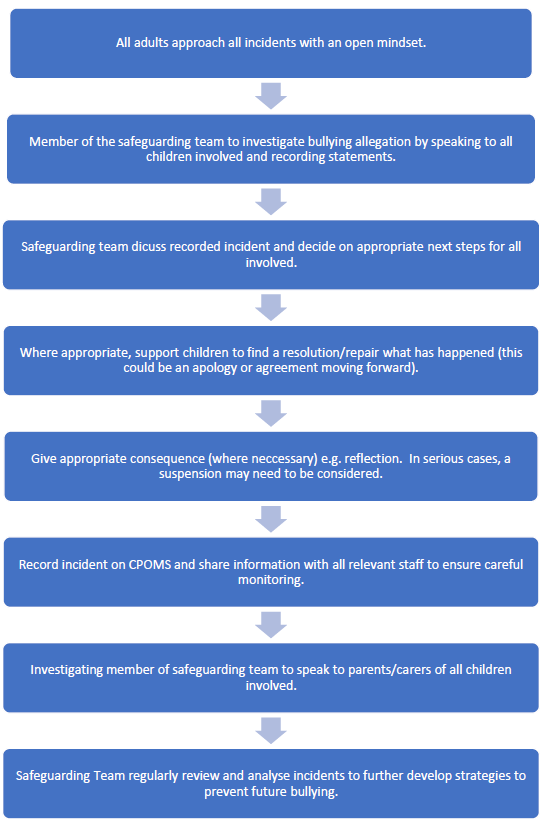
What we do to manage bullying at Woodlands Academy when it does happen:
- All adults approach all incidents with an open mindset.
- Member of the safeguarding team to investigate bullying allegation by speaking to all children involved and recording statements.
- Safeguarding team discuss recorded incident and decide on appropriate next steps for all involved.
- Where appropriate, support children to find a resolution/repair what has happened (this could be an apology or agreement moving forward).
- Give appropriate consequence (where necessary) e.g. reflection. In serious cases, a suspension may need to be considered.
- Record incident on CPOMS and share information with all relevant staff to ensure careful monitoring.
- Investigating member of safeguarding team to speak to parents/carers of all children involved.
- Safeguarding Team regularly review and analyse incidents to further develop strategies to prevent future bullying.
What we do to manage bullying at Woodlands Academy when it does happen: